
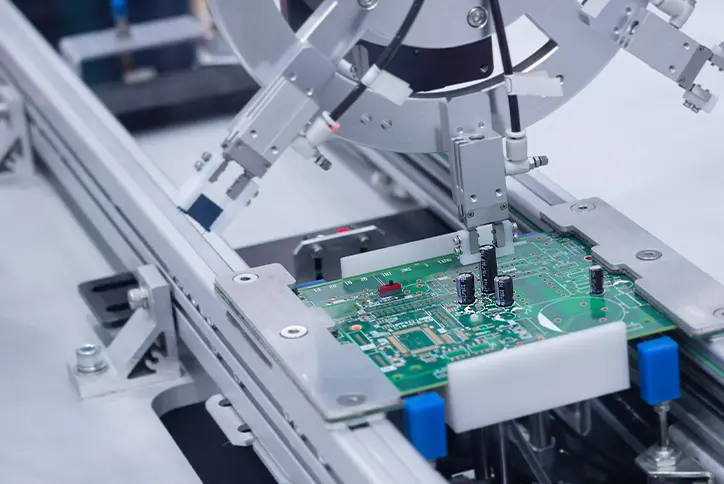
Industrial controls, automotive, medical devices, and military are among the industries that require a balance between electrical performance, mechanical strength, and high reliability. For many applications, mixed-technology, including surface-mount technology (SMT) and through-hole technology (THT) is required to meet the demanding needs. For OEMs, circuit board assembly services for complex mixed-technology PCBs require a provider that understands how the different technologies interact, how the board will move through production, and what inspection and testing are needed to verify the finished assembly. Looking at those requirements early can help prevent assembly problems that are much harder to solve once production has started.
Consider Assembly Processes In Design
A mixed-technology board needs to be designed with its assembly processes in mind. Surface-mount components are placed on pads at the surface of the PCB, while through-hole components have leads that pass through drilled holes in the board. Because of this, component spacing, pad and hole dimensions, soldering access, and the amount of room available around each component must be considered.
The location of through-hole components can be particularly important when they are surrounded by surface-mount devices. A crowded area may make it difficult to apply solder without affecting nearby components, while an unusual component height or location can create clearance problems during production. A design for manufacturability review can identify these issues before they become production problems, when changing the layout is still relatively straightforward.
Plan the Soldering Process
The soldering method needs to match the way the through-hole components are distributed across the board. Wave soldering can solder many through-hole connections in a continuous process, making it useful for appropriate board designs and production volumes. Selective soldering takes a more targeted approach, applying solder to specific through-hole locations, making it useful when surface-mount components or other features prevent the board from going through a conventional wave soldering process.
The board layout, component locations, clearances, thermal characteristics, and required solder connections all affect which approach is practical. In some cases, the assembly process may also involve multiple steps, with surface-mount components assembled and reflow-soldered before through-hole components are inserted and soldered. The manufacturing process should be established around the actual board rather than forcing every mixed-technology assembly through the same sequence.
Think About How the Finished Board Will Be Inspected
Inspection also needs to account for the different technologies on the board. Some solder joints and components can be inspected optically, while other connections may be difficult or impossible to see directly. An inspection strategy should consider which features can be checked automatically, which require another inspection method, and where defects could have the greatest effect on the finished assembly.
That becomes especially important on boards that combine dense surface mount components with through-hole connections. Proper inspection can identify problems in placement or soldering before the board moves farther through production or reaches final testing. IPC-A-610, for example, establishes acceptability criteria for solder joints, through-hole assemblies, and surface mount assemblies.
Decide What Testing the Board Requires
Inspection and testing serve different purposes. Inspection examines how the board was assembled, including component placement and solder connections, while electrical or functional testing determines whether the completed assembly operates as intended. The appropriate testing depends on the product, the circuit, and what needs to be verified before the board moves to the next stage of manufacturing.
Testing requirements are worth discussing before production rather than treating them as an afterthought. A board may require a specific fixture, test procedure, or set of operating conditions that needs to be incorporated into the manufacturing plan. Defining those requirements early also helps establish what information the assembly provider needs from the OEM and what constitutes an acceptable finished board.
Give the Assembly Provider Complete Information
The manufacturing team needs enough information to understand both what the board should look like and how it is supposed to function. That may include the PCB files, bill of materials, assembly drawings, schematics, test requirements, and any specifications that go beyond standard acceptance criteria. Complete documentation gives the assembly provider the information needed to review the design, identify manufacturing concerns, and prepare the production process.
It is also important to discuss expected production volume and any variations between board revisions or product configurations. A prototype or low-volume build may raise different production concerns than a repeatable production program, particularly when component availability, tooling, inspection, or testing requirements change. Getting those details on the table before production starts gives both sides an opportunity to address issues before they affect cost, schedule, or the finished assembly.
Circuit Board Assembly Services from Siemens Manufacturing
Siemens Manufacturing provides circuit board assembly services for mixed-technology boards, including surface mount, through-hole, and BGA assembly. Our capabilities include wave soldering, selective soldering, robotic soldering, axial and DIP insertion, automated optical inspection, and product testing. We also provide design-for-manufacturability and BOM review as part of our electronics manufacturing support.
For an OEM developing a new mixed-technology board or moving an existing design into production, the assembly process should be considered alongside the board design, soldering requirements, inspection strategy, and testing needs. We can review your board requirements and discuss the manufacturing approach for your application. Contact us to discuss your circuit board assembly project.